

To cut a long story short, CIMA Operation Case Study exam – commonly known as OCS, is a 3 hour test of your E1, P1 and F1 knowledge application. Before the exam (on average, around 7 weeks before the exam) you’ll receive a 20-30 page document that describes the company you work for, its environment, and any specific issues the company is having. It gives you context to work with. On the exam day, you are going to receive new information (a.k.a unseen material) and you will be asked questions that you’ll need to respond to based on your technical knowledge and preseen + unseen information. You will have 4 sections and each section will have 2-3 tasks that you will need to answer. Each section will last for 45 mins (so 3 hours in total). As you are going to be completing your exam in specific formats (emails, reports, memos, etc), they will need to be manually marked so you will receive your score after around 6 weeks.
Each level of the CIMA Professional Qualification culminates in a case study examination, which integrates the knowledge, skills and techniques from across the three pillars into one synoptic capstone examination.
The operational level focuses on the short term and the implementation of decisions. At this level, you should be able to work with others in the organisation and use appropriate data technology to translate medium-term decisions into short-term actionable plans.
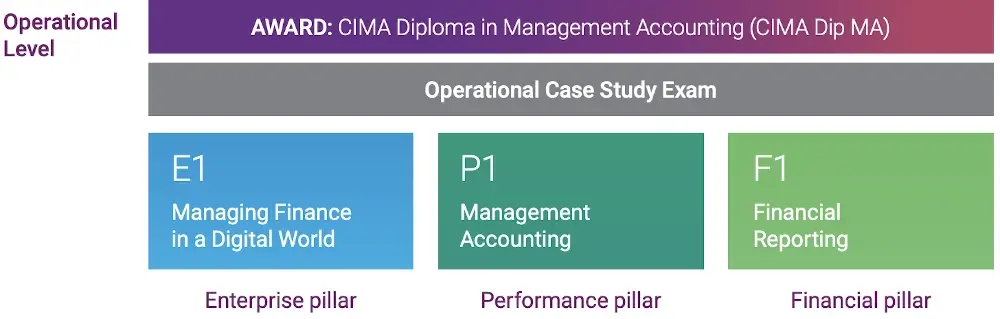
The case study examination is a role simulation, requiring you to respond to authentic work-based activities presented during the examination, applying the knowledge you got from the previous OT papers: E1, P1 and F1 and providing solutions to the issues and challenges you are asked to deal with.
CIMA conducted some research before their last syllabus revision and it came through very strongly from employers that they wanted 2 things from their accountants; they wanted them to be technically strong (which is what the OT exams are designed to test) but they also wanted accountants to be able to function well in the workplace (which is more than just being technically strong).
We can recognise, appreciate and communicate issues by developing practical work-based commercially astute advice.
And this is what the case study is trying to replicate; it’s a work based simulation.
It is not, in any way, trying to retest the OT exams that you’ve passed already.
It’s about putting you in context and seeing if you can function at an appropriate level in an organisation.
The case study exam can be described as a “role simulation”.
Each case study comprises two separate elements:
The preseen information is released in advance of the exam.
The unseen information is provided on the day of the exam.
Those are the screenshots taken directly from the Pearson Vue platform.
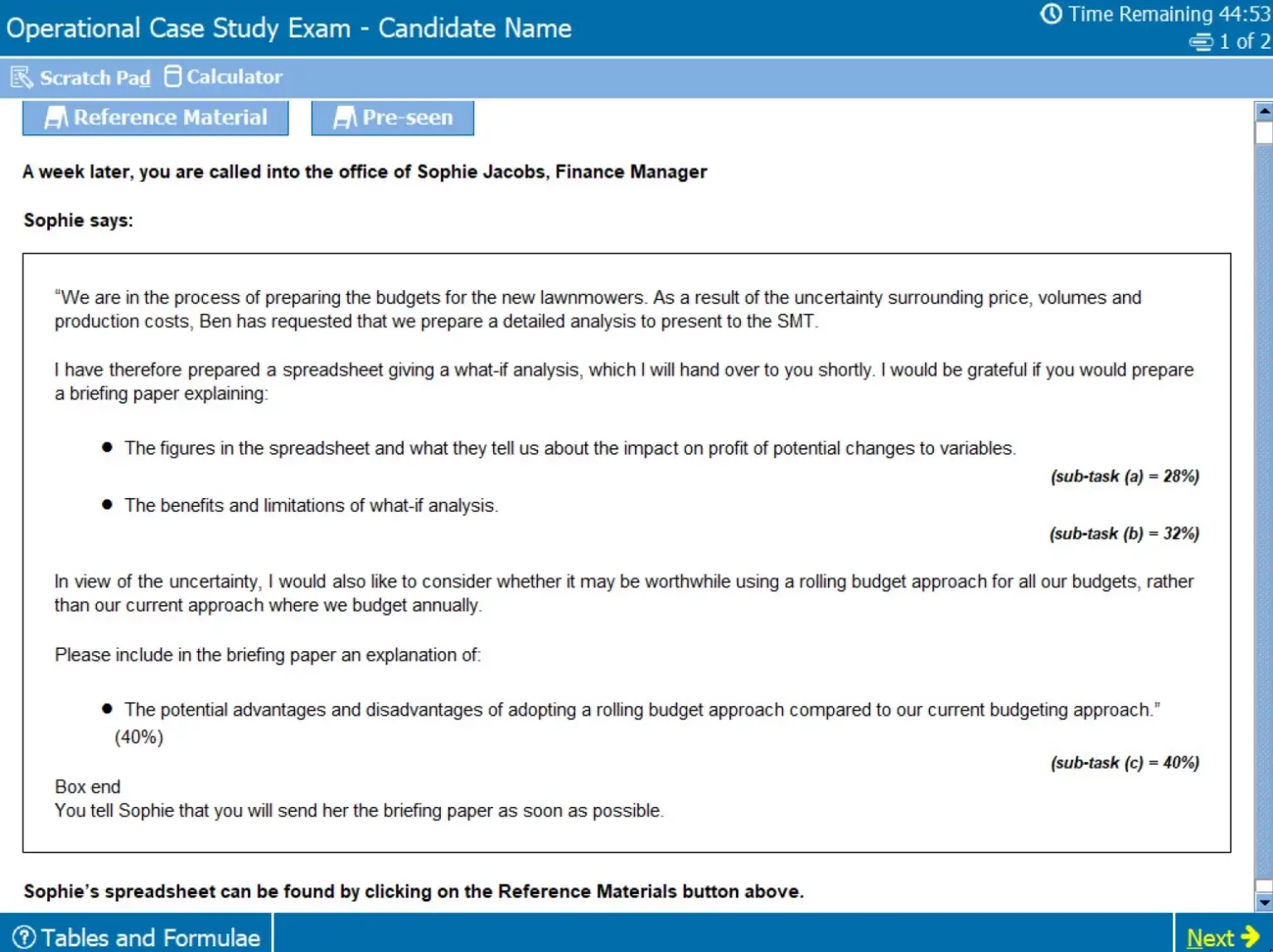

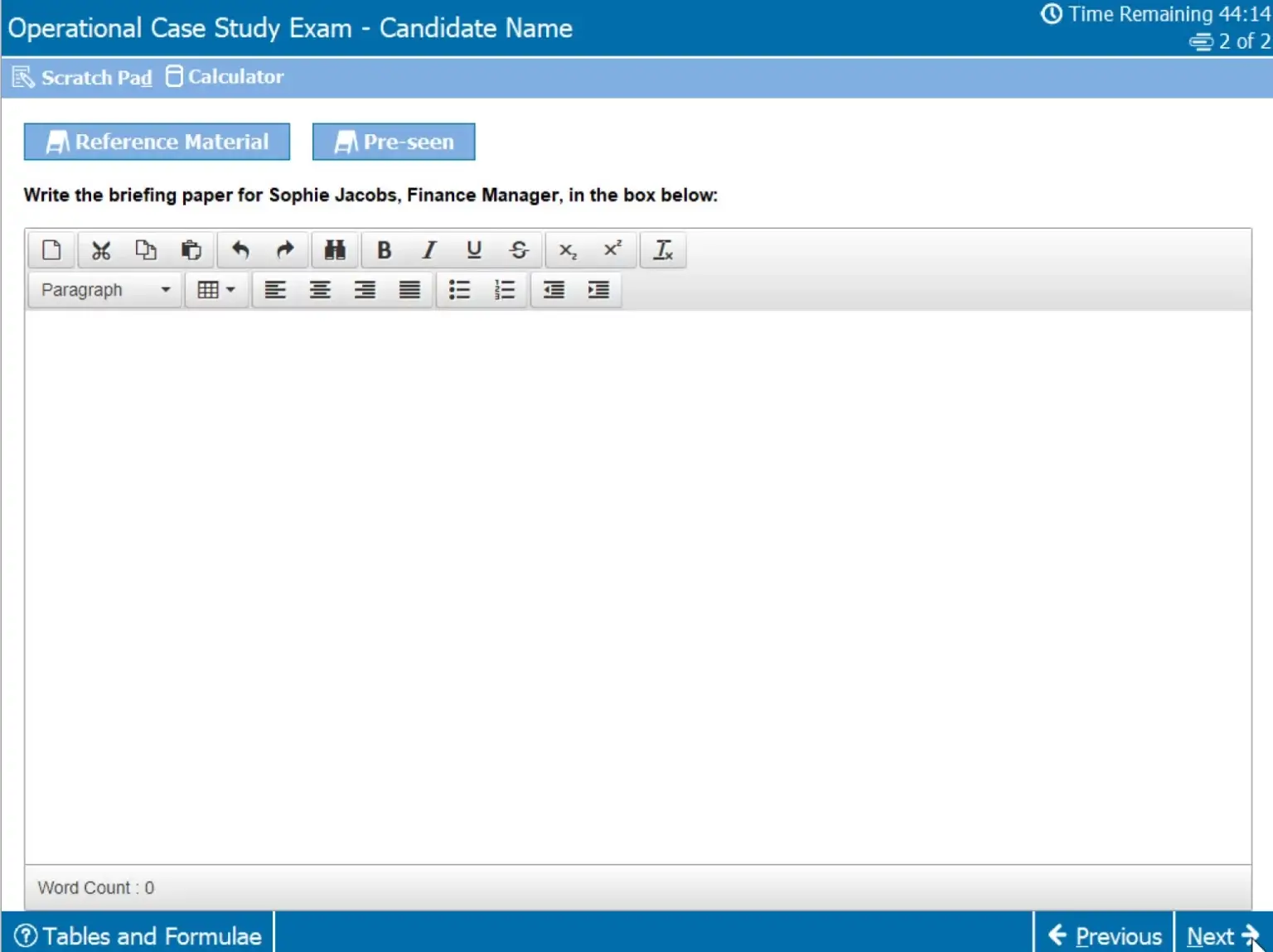
Operational Case Study Exam is a real-world simulation, where you act as a Finance Officer, which is an entry level finance role. Your audience could be: a manager / peer / product owner etc Your tasks will include:

Within each Operational Case Study Examination, six core activities will be assessed. These core activities represent the tasks that are most frequent, critical and important to the Entry level finance professional role.
The six core activities are:
The 6 core activities are linked to associated assessment outcomes expressed in terms of ‘I Can’ statements that speak directly to the skills and competencies that drive the employability of successful learners.
Here is an example of the famous “I Can” statement from above mentioned ‘Activity A’. We’ve added the OT papers where those statements are coming from.


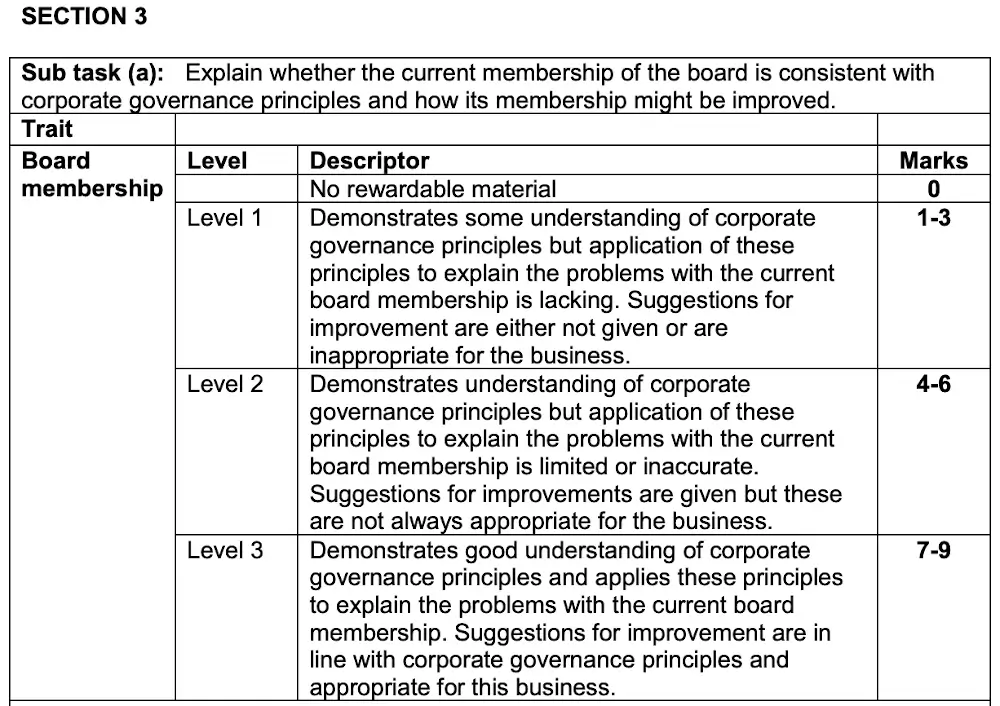
The case study exam is an exam that is marked by a human. You will be given appropriate credit for comments that you make. Broadly speaking, if you make a relevant point, you will get a mark. Additional marks may be given for further explanation and analysis.
Our tutor, in the first part of the OCS preparation package is referring to the so-called “rule of two”. That means that each valid point made will be worth a minimum of 2 marks if it’s correct, relevant and well-explained. Of course in the OCS exam you usually write a bit more, make more comments, hence the whole marking may be more diluted, which means that some comments may be worth only 1 mark. But in general – 2 marks for each valid point.
Your writing technique is fundamental to your OCS success.
Writing technique can mean many things. Here, I just want to focus on the most important bits; structure planning. If you get that right, the rest will follow – and to get that right, you NEED to practise writing answers (meaning you need to do mocks). There is no other way to do it I’m afraid…
When you read the requirement, I’m sure you will have many random thoughts that fly through your head. Having those thoughts is good, but the big mistake here is not writing them down as bullet points, in a structured manner.
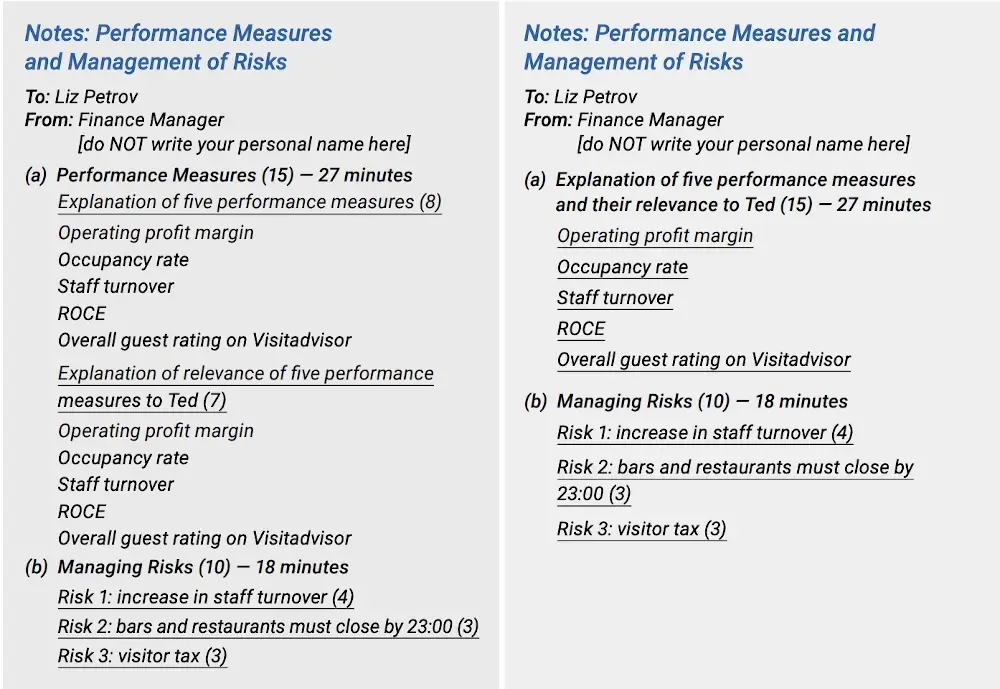
Don’t be afraid to use ‘bold’ and ‘underline’ formatting tools in your exam text editor. Structure planning provides a structured layout that allows you to allocate your time in proportion to the allocated marks and, most importantly, answer ‘all’ requirements in the task.

Don’t spend hours and hours relearning OT’s, you’ve already passed them! You’re not expected to know how to do detailed calculations of the topics tested there BUT, what you are expected to do, is to be familiar with the concepts presented in those E1, P1 and F1 papers and apply them to the scenario.
We believe the best way to do that, is to go through our OCS Revisions videos. Our tutor has recapped all the important parts from the case study POV, so you don’t need to spend weeks revising everything you’ve already passed. We’ve included handy PDFs there too, along with our slides that could be used as your “pocket notes”. Give it a go, I’m sure you won’t be disappointed!
You must be familiar with the content of the preseen, so it is extremely important that you go through it few times. But don’t overdo it. Students have a tendency to learn it almost by heart and that’s not the point here. You’re expected to apply your technical knowledge to the information from the preseen and the new information that you’re going to receive on exam day.
Reading the preseen a few times, highlighting any possible issues and analysing it from the E (Enterprise), P (Performance) and F (Financial) point of view is crucial. One thing I can tell you from my own experience, is that it’s just not worth it to do everything on your own. It takes an incredible amount of time. We’re all busy at work and, as they say, “time is money” – why would you spend your valuable time analysing the preseen and researching the industry while you can use the analysis made by tutors, who are doing that for living and are extremely experienced and knowledgeable? Let them guide you through the whole process. Of course, the best approach is to get 1 to 1 tuition, but that’s very pricey.
Online masterclasses are another option, but here, we’re talking about roughly $674-$1,078 (looking at prices from other tuition providers). And then you have pre-recorded lectures, covering literally everything you need to pass your OCS exam. Compared to the above-mentioned prices, they are very affordable. For example our basic package, with a set of preseen analysis videos, OCS revisions and any other exam preparations videos, plus a number of tasks that forces you to start writing (18 to be exact) and on top of that, 3-5 really high quality mocks will cost you only $187 It really is a big bargain.
Check out the details here for all 4 of our CIMA OCS Study Material packages.
Mocks, mocks and once again mocks! You need to attempt as many as you can before the exam. Of course current preseen related mocks would be best. We offer up to 5 mocks per exam plus extra single tasks that allow you to slowly get into the writing routine right from the start. I have to say – that is innovation on the market! I’ve studied the offers of all the online tuition providers and I’ve asked my own students what they really needed to pass their exams, and most of you said that you needed a guided approach. One where you learn what to do and when.
I’ve done just that. I’ve gathered the requirements, prepared a plan, approached the best Case Study tutors and compiled a set of videos that .
Marking your mocks is another game changer. I understand, overall it is quite pricey, but if you can afford it, it will work like magic. Why? Just imagine that you keep making the same mistake while writing your answers. You won’t know that because no one has ever mentioned anything to you. Then you go to your exam and you do it again. When you get your mocks marked by an independent and experienced tutor, chances are that they will point out exactly what you’re doing wrong, so you can improve that and pass your exam.
We provide a detailed OCS Mocks Marking service as an addition to our mocks

Sign up for our weekly newsletter to receive expert guidance, study resources, career tips, the latest discounts, and more.


Grab your FREE OCS study and practice materials now and boost your chances of passing Operational Case Study exam!


